Once dismissed as merely the city next to Yangzhou, Taizhou has engineered a remarkable transformation into one of Jiangsu province's most sought-after destinations. In 2025, the city recorded 50.7 billion yuan ($7.51 billion) in tourism revenue and welcomed 48.9 million domestic visits, cementing its status as a viral hotspot in the Yangtze River Delta region.
The turnaround began in the countryside. Xinghua's raised-field wetlands, or duotian, carved from low-lying marshes over centuries, earned designation as a Globally Important Agricultural Heritage System in 2014. Their spring rapeseed blooms, filmed from above, earned Xinghua a spot among China's top 10 aerial photography destinations.

Xinghua's raised-field wetlands. [Photo/WeChat account: tztour]
Nearby, Lizhong Water Forest — dubbed the "Jiuzhaigou of Central Jiangsu" — immerses visitors in a canopy of dawn redwoods rising from tranquil waters, while a 12,000-mu (800-hectare) lotus park fills summer with boat rides amid pink blooms.

Autumn view of Lizhong Water Forest. [Photo/WeChat account: tztour]
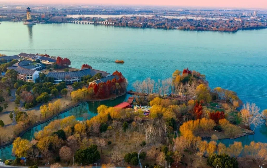
In the ancient city center, the Fengcheng River night cruise has become the signature urban experience, linking pagodas and stone bridges with riverside opera and lantern-lit streets. The restored Daohe historic district, where ancient wells and heritage homes were meticulously preserved by leading conservation architects, now draws crowds of hanfu-clad influencers. Further afield, Qinhu Lake National Wetland Park, a national 5A-rated reserve, rounds out the itinerary with eco-tourism and wellness retreats.

Qinhu Lake National Wetland Park in Taizhou. [Photo/WeChat account: tztour]
The viral momentum was amplified by the city's championship run in the 2025 Jiangsu City Football League, drawing a new wave of curious travelers. Shanghai visitors now rank as the city's largest out-of-province source market. From spring flowers to autumn wetlands, Taizhou's slow-paced water town lifestyle is proving irresistible.